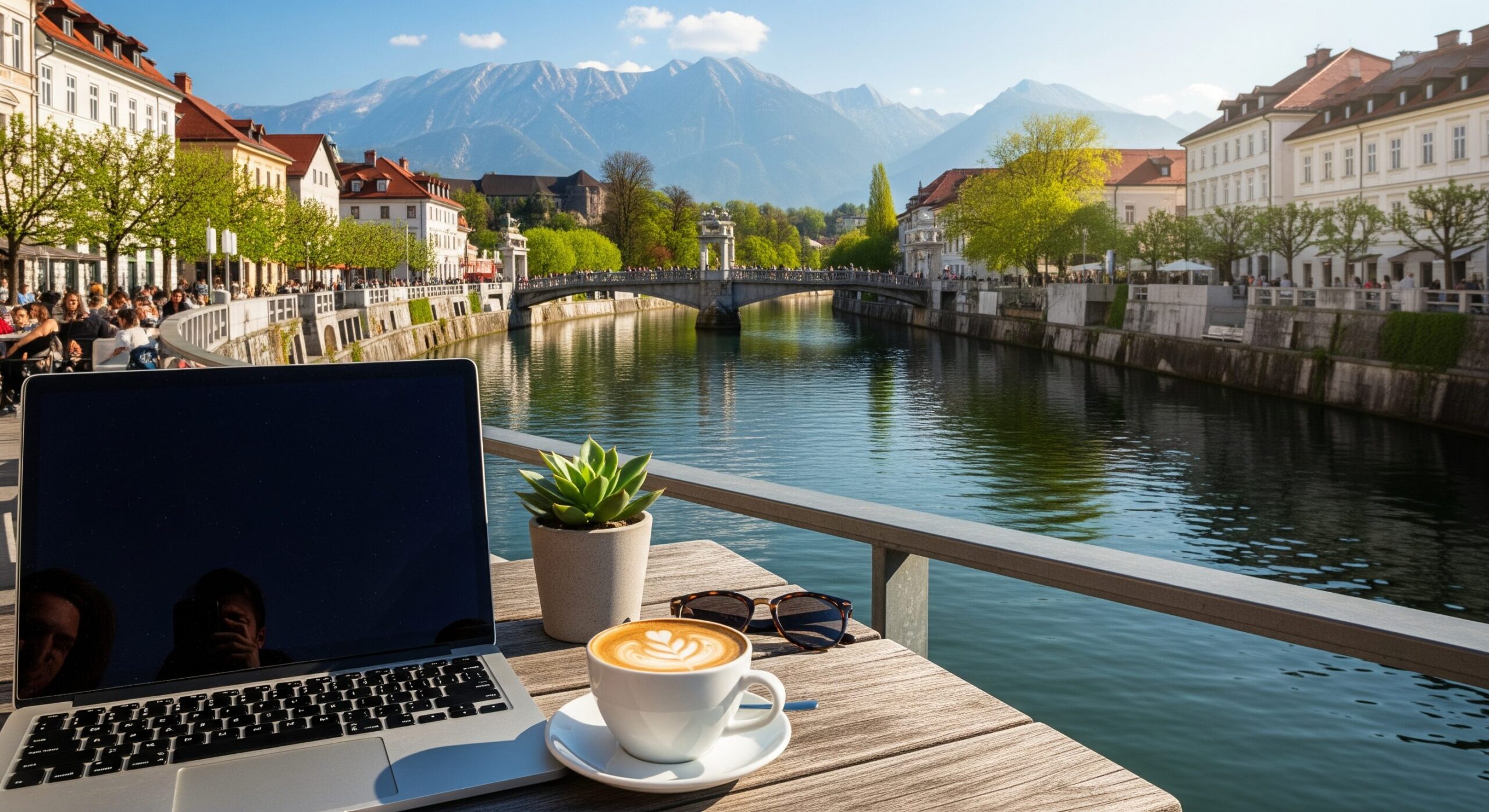
As of 21 November 2025, Slovenia has officially joined the digital nomad visa club with a brand-new 12‑month permit designed specifically for remote workers earning their income abroad. For expats and nomads who want Schengen access, real mountains, and a calmer, cheaper alternative to Portugal or Spain, this might quietly be one of the best new bases in Europe.
The visa targets non‑EU/EEA citizens working remotely for foreign companies or clients, offering legal residence in Slovenia for a year while explicitly protecting the local job market from direct competition. In other words: you get EU lifestyle and mobility, but your income stream stays international — perfect for fully remote employees, freelancers, and online business owners.
Quick facts: Slovenia's digital nomad visa
Here's the high-level snapshot before getting into the weeds:
- Launch date: 21 November 2025
- Validity: 12 months, non‑renewable (you must leave for at least 6 months before applying again)
- Who it's for: Non‑EU/EEA citizens working remotely for employers or clients based outside Slovenia
- Tax angle: You're expected to earn abroad and not take local employment; tax residency depends on time spent and ties, not just the visa
- Mobility: Live in Slovenia and travel the Schengen Area without extra visas while your permit is valid
Compared to some older European schemes that feel bolted onto existing residence categories, Slovenia's is clearly framed from day one as a digital nomad–specific track aligned with the global remote work trend.
Income requirements: higher bar, higher stability
Slovenia isn't chasing budget backpackers; the program is built to attract higher‑earning remote professionals who can genuinely support themselves long‑term. The headline requirement: you need to earn at least twice Slovenia's net average salary, currently sitting around €3,100–€3,200 per month.
What you'll need to show
- Proof you work remotely for foreign employers/clients (employment contract, long‑term freelance agreements, or business registration)
- Recent bank statements or payslips showing consistent income above the €3,100–€3,200 threshold
- A valid passport with at least three months remaining validity beyond your planned stay
- Health insurance covering at least €30,000 in medical costs across Slovenia/Schengen
- A clean criminal record from your country of residence
Most digital nomad visas cluster around the €2,000–€3,000/month mark, so Slovenia sits at the upper end of that range — but you're trading a slightly higher threshold for EU stability, Schengen access, and a very solid standard of living. For mid‑career remote workers, that's a fair swap.
How and where to apply
Slovenia gives you a few paths into the system, which is handy if you're already bouncing around Europe when you decide to make it your base. Applications can be filed:
- At a Slovenian embassy or consulate in your home country
- Through an online application portal as rollout completes (details are being finalized but confirmed as part of the program design)
- At a local administrative unit in Slovenia if you're already in the country on a different legal status
Processing time is quoted at around 30–60 days depending on where you apply and how complete your documentation is. If you apply from inside Slovenia, you can typically receive a temporary residence certificate while your full permit is processed, which is useful if you're already testing the waters on a short‑stay visa.
What about family members?
Slovenia's rules allow your immediate family to join you on dependent residence permits tied to your digital nomad status. They can live, study, and access local services, but they generally cannot work for Slovenian employers under the same permit, which keeps the local job market protected.
For remote workers with partners and kids, this makes Slovenia a serious contender versus single‑only schemes elsewhere. You get an EU base for the family without having to immediately chase traditional local employment or long‑term residence routes.
Why Slovenia might beat the usual suspects
Most people still default to Portugal, Spain, or Croatia when they think "digital nomad in Europe". Slovenia quietly ticks many of the same boxes while avoiding some big‑city headaches.
Location and lifestyle
- Central location: You're a few hours from Venice, Vienna, Zagreb, and the Adriatic coast — ideal for weekend hops while still being based in one place.
- Nature on tap: Lake Bled, Triglav National Park, caves, wine regions, and ski resorts are all day‑tripable, which is rare for a country this compact.
- Urban vibe without chaos: Ljubljana has a legit café culture, riverfront bars, and coworking spaces, but none of the tourist stampede you get in Lisbon or Barcelona peak season.
Cost of living vs other EU hubs
Exact costs vary by lifestyle, but most remote workers can land in roughly the following band for a comfortable solo setup in Ljubljana or similar cities:
- City‑center one‑bedroom apartment: €600–€900 per month; smaller cities and outskirts come in 20–30% cheaper
- Coworking or desk membership: usually €120–€200 monthly in major spaces
- Groceries for one: around €200–€300 monthly
- Public transport pass: roughly €35–€40 monthly
- Mobile + home internet: often €40–€60 combined for fast connections
Compared to Lisbon, Barcelona, or Amsterdam, it's not dirt‑cheap — but you're often looking at hundreds less per month for a similar or better quality of life, especially on housing and eating out. For nomads earning in USD, GBP, CAD, or northern European salaries, that extra runway matters.
Schengen access: the real leverage play
The visa's biggest unlock is simple: you base yourself in Slovenia, but you effectively get the whole Schengen Area as your extended backyard for the year. No additional visas, no overstaying 90/180 rules — just free movement between 27 European countries while your permit is valid.
This changes how you can structure your year:
- Use Ljubljana as your "home office" and bounce to Italy, Austria, or Croatia for long weekends
- Spend a month working from the Greek islands or the Canary Islands while still being legally resident in Slovenia
- Attend conferences, client meetings, or events anywhere in Schengen without paperwork drama
For remote workers who want one legal anchor but don't want to be stuck in a single city all year, this is a huge advantage over non‑Schengen digital nomad destinations in Asia or Latin America.
How this fits into the bigger remote work moment
Slovenia is launching this visa at a time when some governments are actively rolling back remote work freedom. In January 2025, a U.S. presidential memorandum ordered federal agencies to terminate most remote work arrangements and bring employees back to full‑time in‑office roles, with only narrow exceptions. That shift has pushed a lot of people to either change employers or go fully independent if they want to keep location freedom.
At the same time, more than 50 countries worldwide now run some form of digital nomad or remote work visa, with income requirements typically starting around $2,000/month and permit lengths between one and three years. Slovenia joins this group late — but that's actually an advantage, because it has been able to study what works (and what definitely doesn't) in programs from places like Spain, Croatia, and Estonia before rolling out its own.
For remote workers who've just lost domestic work‑from‑anywhere privileges or are worried their company might follow, visas like Slovenia's create a Plan B: keep working for the same employer, but from an EU base where your lifestyle isn't dictated by a new office policy.
Tax basics for expats and nomads (especially Americans)
Slovenia's digital nomad visa doesn't automatically make you a tax resident the second you land — that depends on how long you stay and how deeply you tie your life to the country. Slovenia generally considers you tax resident if you spend more than 183 days per year there or establish it as your center of vital interests (home, family, main economic ties).
For many nomads who split their time between multiple countries, it's possible to stay under tax residency thresholds, but that gets messy fast, especially once you start layering in home‑country rules. U.S. citizens, in particular, are taxed on worldwide income no matter where they live and must keep filing annual returns even on a Slovenian digital nomad visa.
American nomads can often soften the blow with tools like the Foreign Earned Income Exclusion (which shelters a portion of income if you meet physical presence tests), foreign housing exclusions, and foreign tax credits for any Slovenian tax paid if they do become resident there. But those strategies are highly individual — this is the point where a specialist expat tax advisor becomes worth the money.
Bottom line: the visa handles immigration, not taxes. You still need to actively manage your tax position across Slovenia, your passport country, and anywhere else you spend serious time.
Who Slovenia is (and isn't) ideal for
This isn't a "one size fits all" visa, and that's fine. It shines for a certain type of remote worker:
Great fit if you:
- Earn €3,100+/month consistently from foreign sources and want EU stability
- Prefer nature, small‑city life, and four seasons over big‑city chaos and heat waves
- Want a Schengen base but don't love the cost or crowds of Lisbon, Barcelona, or Amsterdam
- Are building a mid‑ to long‑term Europe strategy and want to test the region without locking into classic work/residence permits
Probably not ideal if you:
- Want tropical, year‑round beach weather (Slovenia has snowy winters and real seasons)
- Rely heavily on a huge, pre‑existing digital nomad scene to meet people — Slovenia's community is still early‑stage
- Can't (yet) hit the income threshold and need a lower‑bar visa to get started
Think of Slovenia less as "another hot nomad city" and more as a strategic base: stable, central, and underrated. If your work is fully remote and your income is solid, it gives you EU permanence without the drama of fighting for long‑term residency in a big, saturated hub.
Join the Community
Planning a move to Slovenia or another EU nomad visa country? Join our Discord community at 404officenotfound.com/discord where remote workers actively discuss:
- Real‑world costs in Ljubljana vs Lisbon, Valencia, Zagreb, and beyond
- How tough each visa application actually is once you're in the paperwork
- Tax and banking setups for U.S., UK, EU, and Canadian nomads
- Remote‑friendly employers that truly allow "work from anywhere" in 2025
Bring your situation, income level, and target timeline — there's probably someone already one or two steps ahead of you on the same path.
Join the 404: Office Not Found DiscordSlovenia's digital nomad visa won't stay underrated forever. As more people get priced out or burned out on the usual EU hotspots, countries like Slovenia — small, stable, and strategically located — are exactly where the next wave of remote workers quietly sets up shop. If your employer still lets you work from anywhere, or you're ready to go fully independent, this is one of the most interesting new doors that just opened in 2025.